
By: Tariq Jahan
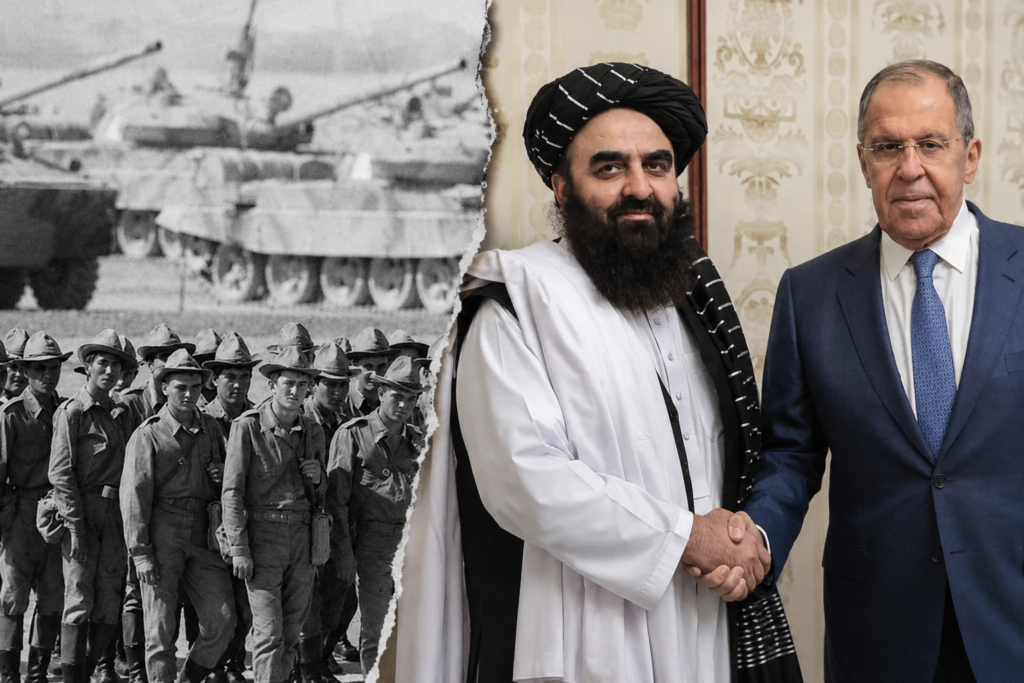
The recently announced military-technical cooperation agreement between Russia and the Taliban marks one of the most remarkable reversals in Afghanistan’s modern history. While the details of the agreement remain undisclosed, its symbolism is impossible to ignore. Russia is now the only country in the world to formally recognize the Taliban government, and this latest agreement further deepens a relationship that would have seemed unimaginable only a few decades ago.
For many Afghans, the announcement carries a sense of historical irony. The Soviet Union invaded Afghanistan in 1979 and spent nearly a decade fighting Afghan mujahideen groups in a devastating war that claimed over a million lives and fundamentally shaped the country’s modern history. Many of the networks, religious movements, and militant circles that later contributed to the rise of the Taliban emerged from that period of resistance against Soviet forces.
Today, however, those historical enemies are speaking the language of partnership, cherishing their newly signed agreement.
“Afghanistan and Russia have long-standing and historic relations, and we want to move forward in this direction.” — Mullah Mohammad Yaqoob, Taliban Defense Minister and son of the movement’s founder, Mullah Mohammad Omar.
The statement highlights how much regional politics have changed. Former adversaries have become strategic partners, not because history has been forgotten, but because interests have changed.
The exact contents of the military cooperation agreement remain unknown as neither side has so far released details regarding its scope, objectives, or implementation mechanisms. As a result, it remains unclear whether the agreement involves arms sales, training programs, technical assistance, maintenance support, or simply a framework for future engagement.
This uncertainty is both important and dangerous. As Russia is heavily stretched by its war in Ukraine and faces significant economic and military pressures, the agreement is likely to prove more symbolic than substantive. Likewise, the Taliban government lacks the financial resources necessary to become a major purchaser of Russian military equipment. The agreement is therefore best seen as a political signal rather than the beginning of a critical military partnership.
Even so, the political significance should not be underestimated. For the Taliban, the agreement provides another opportunity to demonstrate that their government is not internationally isolated. Recognition by Russia and growing engagement with regional powers allow the movement to consolidate its oppressive rule and project legitimacy, particularly, at home. Every diplomatic breakthrough helps the Taliban reinforce the image that they have survived international isolation and secured acceptance from important global actors.
For Russia, the agreement serves several strategic purposes. Moscow remains concerned about the activities of Islamic State Khorasan Province (ISIS-K), particularly after the devastating attack near Moscow in March 2024. Russia views Afghanistan through the lens of regional security and seeks stability along the borders of Central Asia, a region it has traditionally considered within its sphere of influence. Closer cooperation with the Taliban may therefore be viewed as a practical effort to manage security threats and prevent instability from spreading northward.
The agreement also reflects a broader geopolitical reality. Since the withdrawal of the United States and NATO forces from Afghanistan in 2021, regional powers have increasingly competed to shape the country’s future. In addition to Russia, countries like China, Iran, Pakistan, India, and the Central Asian states all view Afghanistan through different strategic lenses, but each recognizes the country’s importance within a wider regional balance of power.
India, for example, has gradually expanded its engagement with the Taliban despite two decades of supporting the former Afghan government. The recent deterioration in Taliban–Pakistan relations has particularly provided India with an opportunity to further expand its engagement with Kabul. By increasing diplomatic contacts and extending assistance following recent crises, New Delhi has sought to improve its standing with both the Taliban leadership and segments of the Afghan public. Additionally, New Delhi understands that disengagement would simply create more space for Pakistani and Chinese influence. Afghanistan is therefore increasingly becoming an arena where multiple regional powers seek influence and strategic advantage.
For Afghanistan, however, the more important issue lies elsewhere. For decades, Afghanistan has often been described as the “graveyard of empires.” While the phrase captures part of the country’s history, it may no longer be the most accurate description. Today, the country increasingly resembles a geopolitical battleground where regional and international powers continue to compete through diplomacy, economic engagement, intelligence activities, and strategic partnerships.
From an Afghan perspective, this is perhaps the most worrying aspect of the Russia–Taliban agreement. International discussions have largely focused on whether Russia could benefit from Taliban fighters, military cooperation, or regional security arrangements. However, many Afghans view the issue from a different angle. The central concern is not whether Taliban fighters might appear elsewhere, but essentially, the continuing cycle in which Afghanistan becomes a theatre for competing external interests.
During the Cold War, Afghan factions became entangled in a conflict between the Soviet Union and the United States, supported by various regional actors. During the post-2001 period, Afghanistan again became the center of an international struggle involving the United States, NATO, Pakistan, Iran, Russia, China, and numerous local actors pursuing competing agendas. Throughout these decades, external support flowed to different political, military, and ideological groups depending on changing strategic calculations.
The result has been a tragic continuity of conflict. Alliances change, partners change, and geopolitical priorities change, but ordinary Afghans repeatedly bear the consequences.
This does not mean that external powers alone are responsible for Afghanistan’s tragedy. The country’s deep internal divisions, political fragmentation, weak institutions, and persistent struggles over legitimacy have repeatedly created opportunities for foreign intervention and influence. External actors have often exploited these weaknesses, but they did not create all of them.
The lesson is therefore both simple and uncomfortable. No foreign power, whether East or West, can guarantee Afghanistan’s stability. No military agreement, diplomatic recognition, or strategic partnership can substitute for domestic legitimacy, inclusive governance, and national unity. As long as Afghanistan remains internally divided, external actors will continue to find opportunities to shape its trajectory according to their own interests.
The Russia–Taliban military cooperation agreement should therefore be viewed as more than a bilateral arrangement. It is another reminder that Afghanistan remains embedded in regional and global geopolitical competition. The names of the actors may change, the alliances may shift, and former enemies may become partners, but the fundamental challenge remains the same.
For many Afghans, the real question is therefore not whether Russia and the Taliban can work together, but whether Afghanistan can eventually escape the cycle in which competing powers repeatedly use Afghan territory, Afghan factions, and Afghan lives to pursue their own strategic objectives.
About the author: Tariq Jahan is a PhD student at the University of St Andrews, researching terrorism and insurgency.
Disclaimer
Opinions expressed here are the authors’ own and do not represent ACSTD.