
By: Tariq Jahan
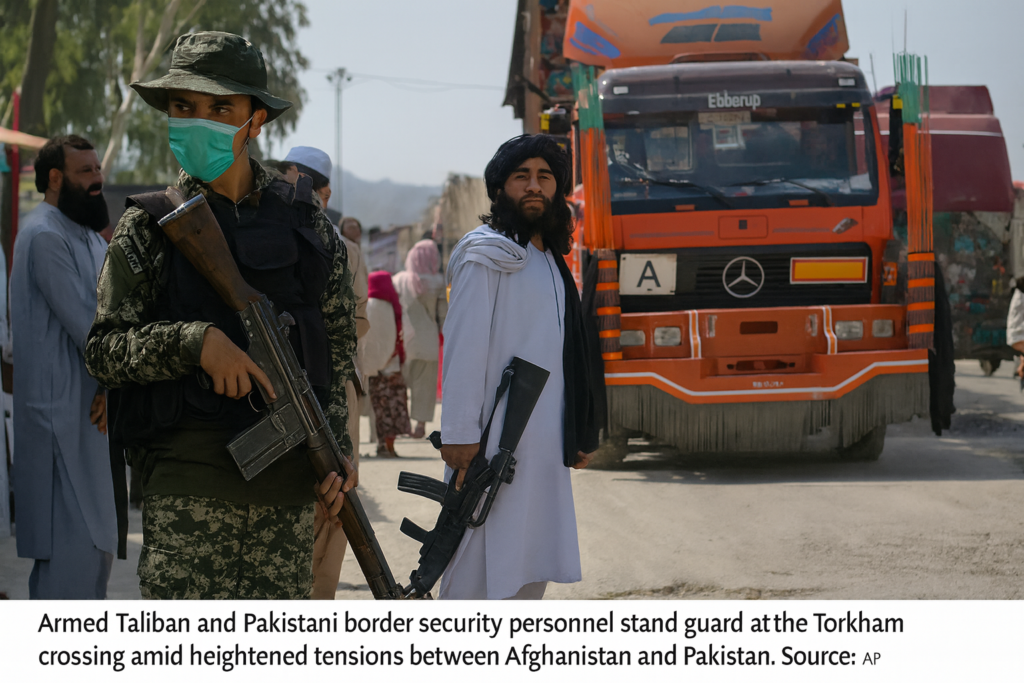
Following Pakistan’s airstrikes on Kabul and other Afghan provinces on 9 October, the Taliban retaliated two days later with heavy and light weaponry along multiple points of the Durand Line. Branded as “Operation Revenge,” the Taliban’s response came amid days filled with major security incidents across Pakistan. Their counterattack resembled a near full-scale confrontation, targeting several Pakistani military outposts with sustained artillery and rocket fire. The hours-long exchanges caused heavy casualties on both sides.
However, according to Taliban statements, before the situation spiraled further, Qatar, United Arab Emirates and Saudi Arabia stepped in and reportedly convinced the Taliban leadership to halt hostilities. This means their mediation helped prevent further escalation.
This commentary argues that the de-escalation and ceasefire should be welcomed by both governments and peoples, not because the conflict was resolved, but because it prevented far greater harm to both nations and to regional stability. Three main reasons support this argument: political weakness, military imbalance, and humanitarian vulnerability, particularly on the Afghan side.
Political weakness
Since August 2021, Afghanistan has lacked a representative, inclusive, and internationally recognized government. This political vacuum means the country’s sovereignty, while theoretically intact, carries little diplomatic weight. No nation condemned the Pakistani airstrikes on Kabul—a blatant violation of Afghan territory—precisely because the Taliban regime remains unrecognized. Had the conflict continued, Afghanistan would have faced an impossible legal and diplomatic situation. No UN body or international organization would have intervened neutrally or condemned Pakistan’s actions. As a recognized state, Pakistan would have held the upper hand in the international arena. Afghanistan, under Taliban rule, would have received neither sympathy nor support. In this context, a prolonged confrontation would have been politically disastrous for Afghanistan, exposing its isolation and deepening its legitimacy crisis.
Military imbalance
Afghanistan is vastly weaker than Pakistan in terms of both conventional military capability and technological assets—fighter jets, drones, missiles, and command structures. Even though Pakistan is itself struggling with serious internal instability—mass protests, an economic downturn, and resurgent militancy from groups such as the Tehrik-e-Taliban Pakistan (TTP) and the newly emerged Tahafuz-e-Emirate-Islami Force (Islamic Emirate Protection Force), which claimed the 11 October attack on a police training center in Khyber Pakhtunkhwa—the overall balance of power still tilts heavily in Islamabad’s favor. An extended border conflict could have caused damage to Pakistan but would have devastated Afghanistan. The Taliban might have projected defiance, but Afghanistan had zero chance of emerging militarily victorious. In short, this was not a winnable war for either side, but it was an unwinnable one for Afghanistan.
Humanitarian fallout
Perhaps the strongest reason to welcome the ceasefire lies in its humanitarian implications. Afghanistan is already facing a worsening economic and social crisis: widespread poverty, drought, and food insecurity compounded by mass deportations of Afghan refugees from Iran and Pakistan. Thousands of forcibly returned families are being repatriated into a country already struggling to assist earthquake victims in Kunar and elsewhere. With winter only days away, another military escalation would have multiplied displacement, hunger, and suffering among ordinary Afghans while sparing much of the Taliban’s leadership. Given the regime’s weak governance capacity, limited aid inflows, and global fatigue with Afghan crises, even a brief conflict risked triggering a humanitarian catastrophe. In this sense, the ceasefire was not merely a pause in fighting; it was a life-saving development.
While external involvement in Afghan affairs has historically been self-interested and often destructive, the roles played by Qatar and Saudi Arabia this time deserve recognition. Their mediation represents a rare moment of constructive, pragmatic regional diplomacy. It offers a potential model for future crisis management, prioritizing dialogue and mutual security concerns over confrontation. For Afghanistan and Pakistan alike, responsible diplomacy, not military brinkmanship, is the only viable path forward. Both countries share serious internal challenges—terrorism and militancy, economic strain, and political instability—and continued conflict would only strengthen non-state actors seeking to exploit their weaknesses.
In essence, the October ceasefire prevented a regional disaster. Afghanistan’s political isolation, military weakness, and humanitarian fragility meant that continued warfare could only have deepened its suffering. While the Taliban’s unpredictability and Pakistan’s assertiveness remain major concerns, this moment of restraint deserves cautious celebration. Sustaining peace now depends on whether both sides can replace escalation with engagement and move from reaction to responsibility.
About the author
Tariq Jahan is a PhD student at the University of St Andrews researching terrorism and insurgency.
Disclaimer
Opinions expressed here are the author’s own and do not represent ACSTD.