
By Tariq Jahan
On the night of 9 October 2025, the skies above Kabul—the heart of Afghanistan—were pierced by Pakistani airstrikes. Pakistan claimed it was targeting the leader of Tehrik-i-Taliban Pakistan (TTP), yet the strikes also hit civilian areas and destroyed shops in Paktika province. Though no casualties have so far been reported, the incident marked the first time Pakistan bombed the Afghan capital itself. This was not an isolated act. For decades, Islamabad has justified cross-border attacks under the banner of counterterrorism, while simultaneously cultivating militant proxies inside Afghanistan. The latest strikes reveal Pakistan’s enduring strategy of control, denial, and manipulation, threatening Afghan sovereignty and stability.
Pakistan’s interference in Afghan affairs is as old as its own statehood. From the 1980s Afghan jihad against the Soviet Union to the Taliban’s first regime in the 1990s, Pakistan’s military and intelligence apparatus has sought to keep Afghanistan within its strategic orbit. With U.S. and Saudi funding, Pakistan trained and armed the mujahideen, portraying the effort as an act of solidarity while securing international aid and influence. After the Soviet withdrawal, Islamabad shifted its backing to the mujahideen and later the Taliban, hoping to create a compliant regime that would give Pakistan “strategic depth” against India. Following 2001, Pakistan publicly joined the U.S.-led war on terror but privately maintained safe havens for the Taliban leadership in both secure and tribal regions across Pakistan. This double game—supporting Western counterterrorism while enabling anti-Afghan insurgents—became a defining feature of its foreign and security policy.
Pakistan’s success in manipulating Afghanistan’s destiny has often relied on Afghan disunity, internal fragmentations. The absence of political consensus and recurrent power struggles among Afghan factions created openings for Pakistani interference. By financing, hosting, or mediating rival groups, Islamabad turned Afghan instability into strategic opportunity. Every time Afghans failed to speak with one voice, Pakistan spoke for them. This pattern persists: Afghanistan’s internal fragmentation remains Islamabad’s strongest weapon.
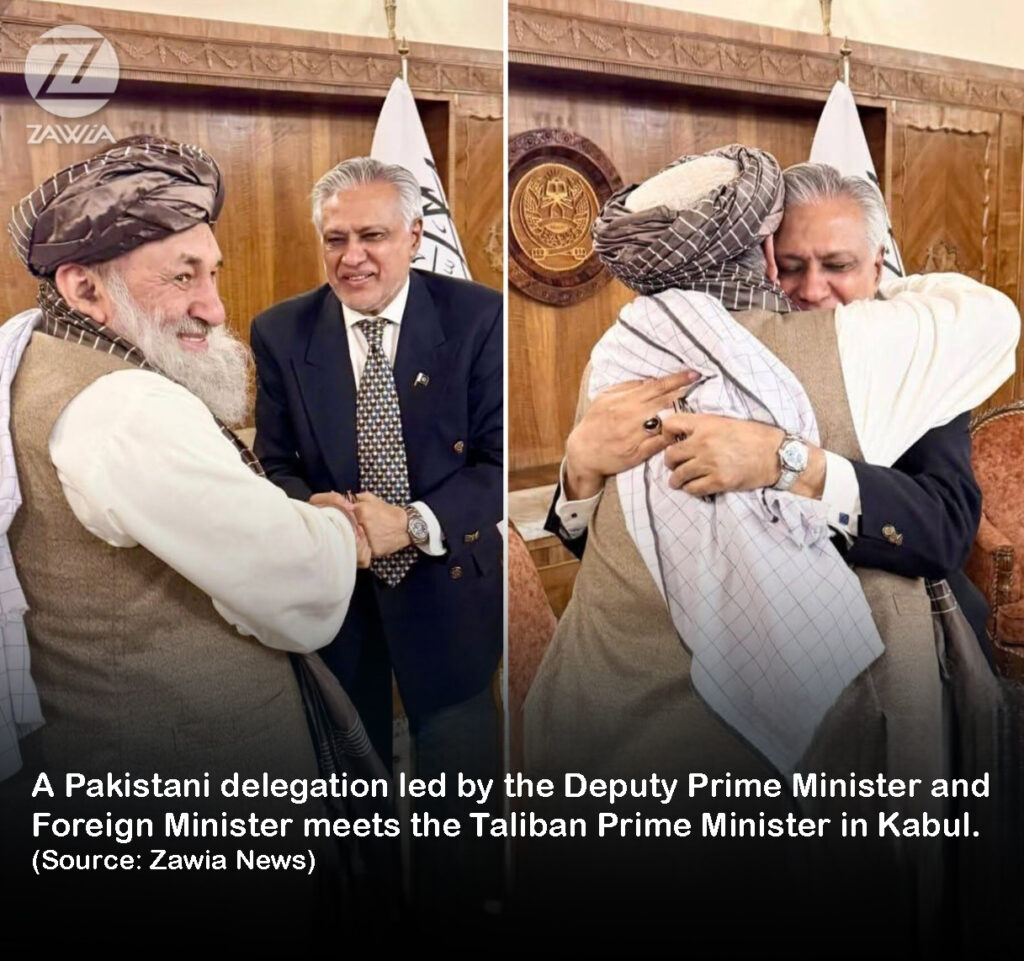
When the Taliban seized Kabul in August 2021, Pakistan’s political and military establishment declared victory. Former Prime Minister Imran Khan and current Defence Minister Khawaja Asif were among other Pakistani leaders who celebrated the Taliban’s return to Kabul, proclaiming that Afghans had “broken the shackles of slavery.” Their statements not only endorsed the Taliban’s takeover but also mirrored the group’s propaganda rhetoric. Crowds in Pakistani cities cheered the Taliban’s return, and the ISI chief travelled to Kabul to help shape the new government. For a brief moment, Islamabad believed it had achieved its decades-long dream: a friendly, dependent Taliban regime ensuring that no government in Kabul would pursue its independent foreign policy. That illusion quickly shattered. Since 2022, Pakistan has faced an unprecedented surge in militant attacks by the TTP and allied factions operating from within its own territory. The Taliban’s refusal to act decisively, official Pakistani rhetoric, against the TTP has angered Islamabad, exposing the limits of Pakistan’s leverage over the very movement it once nurtured. The Pakistani military’s long-standing distinction between “good Taliban” (Afghan) and “bad Taliban” (Pakistani) collapsed. The militants trained in Pakistan’s proxy wars have turned their guns inward. In fact, Pakistan’s quest for strategic depth has produced strategic blowback.
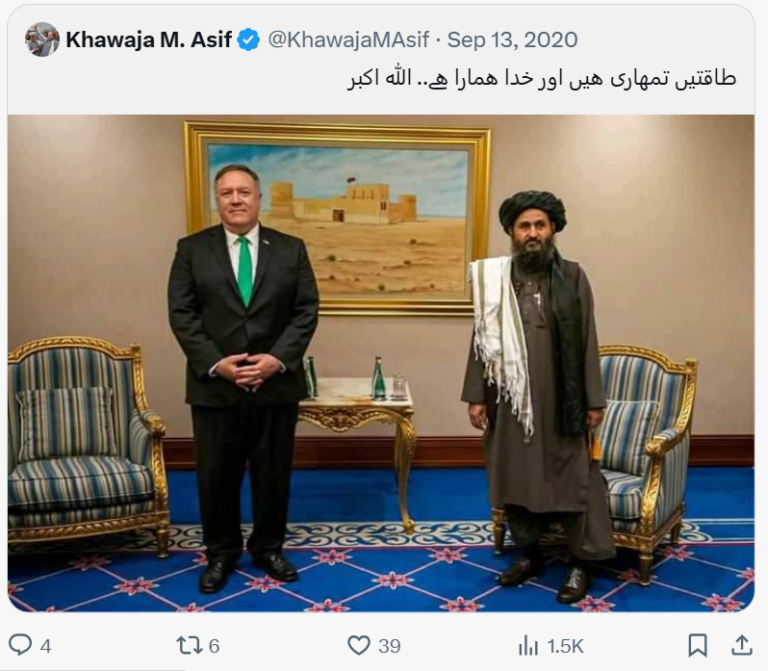
In 2020, Pakistan’s current Defense Minister (then Foreign Minister) Khawaja Asif shared this photo of Mike Pompeo with Taliban leader Mullah Baradar, writing: “طاقتیں تمہاری ہیں اور خدا ہمارا ہے.. اللہ اکبر” — “The powers are yours, and God is ours… Allahu Akbar.”
The October airstrikes carried multiple implications. Militarily, Pakistan frames them as a response to cross-border terrorism, repeatedly vowing to target ‘terrorist hideouts’ inside Afghanistan. Politically, they carry a calculated message to the Taliban, to India, and to Pakistan’s own domestic audience. First, the strikes coincided with Taliban Foreign Minister Amir Khan Muttaqi’s visit to New Delhi, where discussions focused on potential cooperation and regional dialogue. For Islamabad, the image of the Taliban engaging diplomatically with India is intolerable. By striking Kabul at that very moment, Pakistan signaled both its anger and its continued dominance over Afghan affairs. Second, the airstrikes served as a domestic distraction. Pakistan faces spiraling internal insecurity and political disarray. Each time a major attack hits its territory, officials quickly point fingers at Afghanistan, redirecting public frustration away from the state’s own failures. Finally, the strikes were a symbolic assertion of power. Targeting sites near Kabul’s Defense Ministry and the Presidential Palace was not about destroying militants but about reminding Afghans who still claims the upper hand. Therefore, Pakistan bombs Kabul not to fight terrorism, but to remind Afghans of their vulnerability.
The attacks can have strategic consequences. It undermines whatever fragile trust existed between Kabul and Islamabad, heightens anti-Pakistan sentiment among Afghans, and risks renewed border confrontations. Regionally, the timing could push the Taliban closer to India, wary of Pakistan’s assertiveness. China, Pakistan’s main ally, will also view the instability with unease, given its own security concerns over militancy in the region and re-emergence of U.S. footprint in Afghanistan. For Afghanistan, the airstrikes reinforce a painful reality: its sovereignty remains precarious. With no internationally recognized government and air defenses, Afghanistan cannot deter or respond effectively. The message to Afghans is stark—external actors still determine their fate. For Pakistan, meanwhile, these strikes may offer short-term political relief but deepen long-term insecurity. By attacking a neighbor already in multiple crises, Islamabad fuels further resentment and potentially expands the very threats it seeks to contain.
Pakistan has long invoked the rhetoric of counterterrorism to justify actions that consolidate influence rather than eliminate threats. For two decades, while claiming to be a frontline ally in the war on terror, it channeled funds, fighters, and ideology across the Durand Line to weaken the Afghan state. Now, with the Taliban in power, Islamabad’s narrative has simply reversed: instead of Afghan insurgents destabilizing Afghanistan, it blames Afghan territory for destabilizing Pakistan.
Pakistan’s airstrikes on Kabul mark a violent, aggressive change in its Afghanistan policy. They demonstrate that Islamabad still views its western neighbor not as a sovereign state but as a security buffer to be managed through pressure and proxies. Such actions, however, are self-defeating. Every missile fired into Afghan soil deepens mistrust, strengthens anti-Pakistan sentiment, emboldens insurgent groups, and undermines prospects for genuine regional stability where both nations, above all, could instead pursue peace, stability, and progress. Afghanistan’s future cannot be shaped through coercion or manipulation. For Pakistan, the path to real security lies not in dominating Kabul but in ending the double game—engaging sincerely with Afghans, respecting their sovereignty, and cooperating to confront shared threats of terrorism, militancy, and extremism across the region, free of hidden agendas. Until that happens, both nations will remain trapped in a perpetual cycle of insecurity and violence, retaliation, and distrust while the illusion of counterterrorism continues to mask the deeper tragedy of a relationship built on control rather than coexistence.
About the author
Tariq Jahan is a PhD student at the University of St Andrews researching terrorism and insurgency.
Disclaimer
Opinions expressed here are the author’s own and do not represent ACSTD.
Photo credit
Social media