
The start of September brought a series of earthquakes that flattened villages in eastern Afghanistan, particularly in Kunar province. Entire communities were reduced to rubble, and the death toll passed 2,000. This was not the first disaster to strike since the Taliban took power in August 2021. Afghanistan, already fragile, has faced multiple natural crises in recent years. What makes this case different is not only the devastation, but the way the Taliban responded at home and abroad.
Two dynamics stand out. First, the speed of international response, with neighboring states and global actors rushing to provide emergency relief. Second, the Taliban’s strategic use of the disaster as a platform for diplomacy and public relations. Together they raise an uncomfortable question: are natural disasters becoming a tool for the Taliban to win sympathy, strengthen their rule, and seek legitimacy?
The Taliban leadership, particularly their foreign minister, wasted little time after the earthquakes. Within hours, messages of condolence and offers of support poured in, directed mainly at the Taliban’s Ministry of Foreign Affairs. At the same time, Taliban officials appeared at disaster sites, livestreamed on Facebook and TikTok with poetry and taranas playing in the background, as they rushed to pull survivors from the rubble and assist those displaced. Citizen journalists, embedded reporters, and Taliban-influenced charities amplified these images. In parallel, international coverage by the UN, aid agencies, and foreign governments, suddenly placed Afghanistan back on the global agenda.
For a movement often isolated diplomatically, such moments are invaluable. Whether or not these contacts yield long-term recognition, they provide immediate attention. The Taliban can point to foreign governments, UN agencies, and regional powers engaging with them during crisis response as proof that they are not outcasts but the de facto rulers of Afghanistan. In a world of shifting crises, just having Afghanistan mentioned at the UN or in regional summits is seen as a diplomatic win.
Domestically, the Taliban work just as hard to frame themselves as protectors of the Afghan people. Senior officials appear quickly at disaster sites, often with cameras in tow. Even when the aid delivered is minimal or poorly coordinated, the emphasis is on visibility. Some officials have gone as far as circulating fabricated AI-generated photos to show that the Emirate is working “tirelessly.”
These performances matter. For many Afghans, daily life under Taliban rule is defined by poverty, repression, and a lack of services. Crises become moments to project a different image: of leaders on the ground, concerned, acting decisively, and in control. The Taliban’s use of music, religious chants, and visual propaganda creates emotional resonance that can overshadow the inefficiency of the actual response.
Foreign governments typically deliver aid on humanitarian grounds. Yet in Taliban-controlled Afghanistan, aid is never just humanitarian. When supplies arrive with the tricolor national flag, the Taliban seize the opportunity to rebrand them as symbols of their authority. Packages distributed through Taliban channels are filmed and broadcast as proof that the Emirate cares for its people.
The reality is more complicated. Women, minorities, and former government employees often face discrimination in aid distribution. The lack of female health workers means women in disaster zones are frequently underserved. In some areas, aid is diverted or selectively distributed to Taliban supporters. In practice, humanitarian relief becomes another tool of political control.
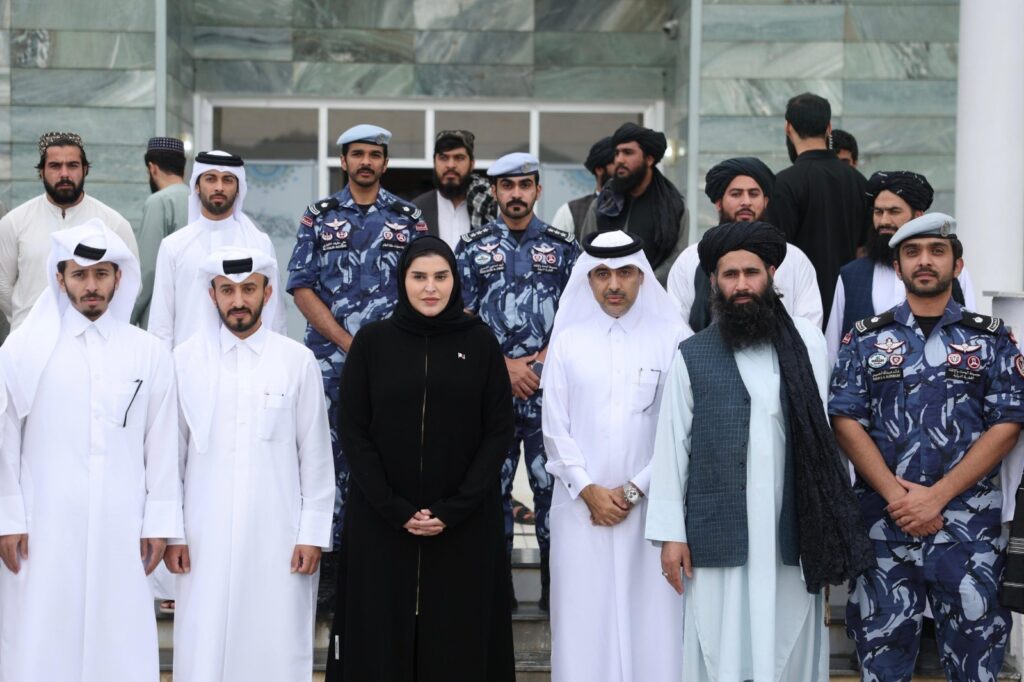
The risk is clear: international support, however well-intentioned, can inadvertently strengthen the Taliban’s domestic legitimacy. What donors intend as a neutral gesture is reframed as endorsement. Crises also allow the Taliban to deepen ties with sympathetic governments. Countries like Qatar, China, Russia, Pakistan, and Iran were among the first to respond after the Kunar earthquakes. They not only delivered relief but also provided platforms for Taliban diplomacy. Such gestures reinforce the Emirate’s narrative that it has reliable partners even if Western recognition remains distant.
For the Taliban, these relationships are leverage. They can demonstrate to Afghans that powerful states are willing to cooperate with them, while at the same time signaling to Western capitals that isolation is futile. In this way, natural disasters become diplomatic stages where legitimacy is rehearsed and projected.
What makes this strategy striking is the Taliban’s selective embrace of international norms. When international law or humanitarian principles favor them such as disaster relief or negotiations on refugee repatriation, they welcome it. When those same norms challenge their ideology on women’s rights, freedom of expression, or inclusive governance, they reject and even condemn them.
This contradiction reveals the instrumental nature of Taliban diplomacy. Crises are not primarily about saving lives but about reinforcing their position at home and abroad. Relief operations are framed as evidence of effective governance, even when delivery is slow, selective, or inadequate.
The consequences of this pattern are significant. Humanitarian aid, while intended to save lives, often boosts the Taliban’s legitimacy by reinforcing their claim to be Afghanistan’s rightful rulers. Even limited engagement with the regime during crisis coordination is reframed or at the least seen by Afghans as a form of international recognition. At the same time, aid distribution is frequently discriminatory, leaving vulnerable groups, especially women, excluded or underserved. Most concerning, crises are treated less as moments of accountability and more as opportunities for public relations, allowing the Taliban to project authority and competence without addressing underlying governance failures.
Disasters will continue to strike Afghanistan, from earthquakes to floods and food insecurity, making humanitarian aid essential. Yet the key lesson for the international community is that such assistance must be designed and delivered in ways that minimize political misuse. Foreign governments and aid agencies should prioritize delivering aid directly to affected populations rather than relying entirely on Taliban distribution networks, while monitoring and reporting transparently to ensure women and marginalized groups are not excluded. They must also avoid symbolic gestures, such as publicized handovers to Taliban officials, which can be exploited for political gain. Above all, engagement should be framed strictly in humanitarian terms, resisting Taliban efforts to portray crisis response as diplomatic recognition.
Afghanistan’s recent earthquakes remind us of the human suffering that disasters bring. But they also highlight how the Taliban turn tragedy into political opportunity. For the Emirate, crises are not only emergencies; they are stages to project authority, cultivate sympathy, and press for recognition.
For the international community, the challenge is to balance compassion with caution. Aid must flow, but legitimacy must not. Simply put, for the Taliban, even an earthquake becomes a diplomatic opportunity.
About the author
Tariq Jahan is a PhD student at the University of St Andrews researching terrorism and insurgency.
Disclaimer
Opinions expressed here are the author’s own and do not represent ACSTD.
Photo credit
Doha News.